Part 0 of a personal log on Bitcoin.
- Part 0: I Wrote This in 2017. I Still Believe Most of It. (this article)
- Part 1: Bitcoin in 2026: A Reality Check (coming soon)
I found this article sitting as an unpublished draft on Medium, written on December 14, 2017, while I was at Blocko Ventures, a blockchain spin-off from eSapiens (opens in a new tab). I wrote it to organize my own thinking and publish it under Blocko's name — but it never made it out. By early 2018, the work we'd been doing there was already pushing us toward something bigger: co-founding Investtor, a cryptocurrency platform. The draft followed me there, sat in review, and I kept postponing it. That's a story for a future article.
Reading it now, almost nine years later, most of it still holds up. But some observations deserve a closer look. In 2017, I compared blockchain to the internet in 1994 and implied mass adoption was around the corner. That didn't happen. El Salvador tried to force it by making Bitcoin legal tender — and it didn't stick. If we keep the internet parallel, by 2004 the web had already advanced far beyond where Bitcoin sits in 2026. Meanwhile, AI exploded into the mainstream precisely because ordinary people could just open a browser and start using it — no wallets, no private keys, no gas fees. Bitcoin still doesn't have that moment.
These are things I want to explore in this series. But first, the article itself — translated from Portuguese, and ironically, the only piece in this blog that I wrote entirely without AI. Though I am using it to translate this one.
The society of the future is being built
Originally written on December 14, 2017.
The technology that will transform the way we live in society is being built, and you've probably already heard someone talking about it. The Blockchain — the technological foundation of Bitcoin.
Sit tight, here comes a story
We are part of a digital revolution that has been unfolding over the past 25 years, and the internet is the main driving force behind it. The way we buy and sell products has been transformed — today we no longer need to leave the house to buy that new shirt or sell that old TV. The internet gave us the power to trade with anyone in the world. But the internet also has its problems, and one of them is the lack of trust. You have no way of truly knowing who you're talking to or doing business with.

The cartoon "On the Internet, nobody knows you're a dog (opens in a new tab)" drawn by Peter Steiner in 1993 still makes a lot of sense. A person can create a profile on the internet and claim to be whoever they want — even a dog. We have no way of truly knowing a user's identity.
Want an example? In 2008, a person — or a group of people, or who knows, maybe even an alien (who could tell?) — going by the name Satoshi Nakamoto sent a document to a mailing list titled "Bitcoin: A Peer-to-Peer Electronic Cash System", describing a network of people who would sustain a digital money system.
Back to the internet — remember the trust problem I mentioned? Well, it's not exactly a problem anymore. We've found ways to work around it. We created services to centralize trust. Take Airbnb, for example — it's nothing more than a trust centralizer. When we book a room, we trust Airbnb enough to go sleep in a stranger's house, or to let a stranger come sleep in ours.
And why do we do this? Because these services sell us trust. Instead of trusting people directly, we pay a service that both parties trust to carry out a transaction. And that's just one example. Want more? Google, Facebook, Uber, banks, and even governments — all of them are examples of services that sell trust. The services we use are centralized.
What's wrong with using centralized services?
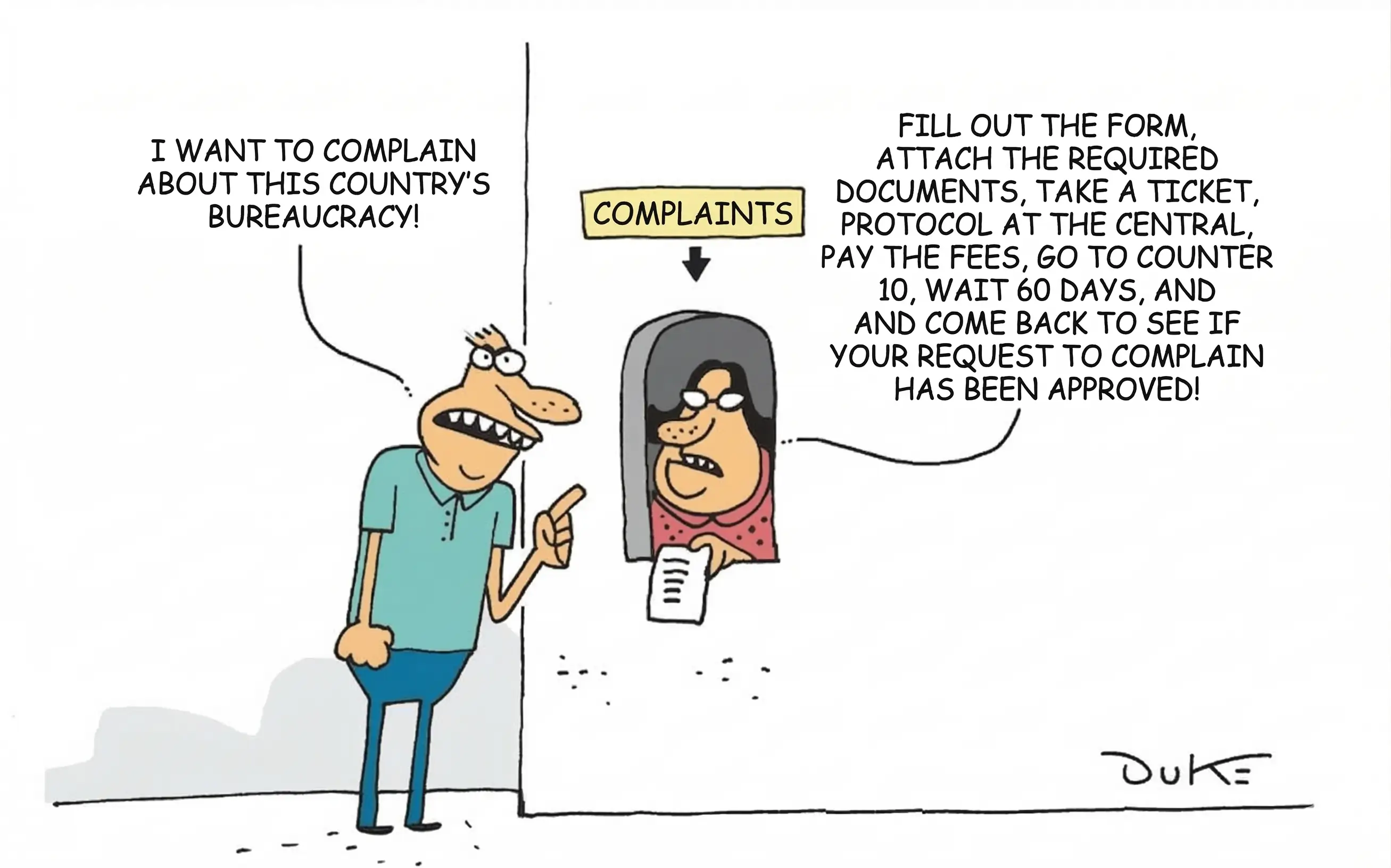
Centralized services are usually bureaucratic and expensive, and in many cases also inefficient — just look at governments and traditional banks. And that's not all: in centralized services, we don't have control over our own information.
Have you ever stopped to think about how much companies profit from your information? If you haven't, it's time to start paying attention. Your search history, the photos you like, the articles you read, the people you talk to — all of this can be used to sell advertising space targeted at you. And what do you get in return? Nothing.
I'm not against these services — I use them a lot, actually. I quite like it when content comes to me right when I need it.
In centralized services, the biggest problem is still the control of information. The data of many users is concentrated in the hands of a few. Do you know how many users Facebook has worldwide? More than 2 billion (opens in a new tab). That's a lot of information in the hands of a single organization.
The past is centralized, complicated, and bureaucratic
Throughout human history (so far), we've organized ourselves into groups with a central figure. Indigenous peoples had their chiefs, kingdoms had their kings, governments have their rulers, and companies have their presidents.
This was always necessary because we had no way to reach consensus on decisions, so we delegated power to a representative to act on our behalf.
The future will be decentralized, transparent, and connected
Remember the digital money I mentioned at the beginning? Bitcoin? It is all of this, and the technology it was built on — the Blockchain — is what makes it possible.
- Decentralized: decision-making power will be distributed among everyone
- Transparent: information will be available whenever it's needed
- Connected: a global information network managed by its users
The moment, 2017
During this year, Bitcoin — already considered digital gold — became popular among ordinary people. Interest grew enormously due to its massive price appreciation. Bitcoin became a topic in bar conversations, elevator chats — you even hear people talking about it on the street, showing genuine curiosity.
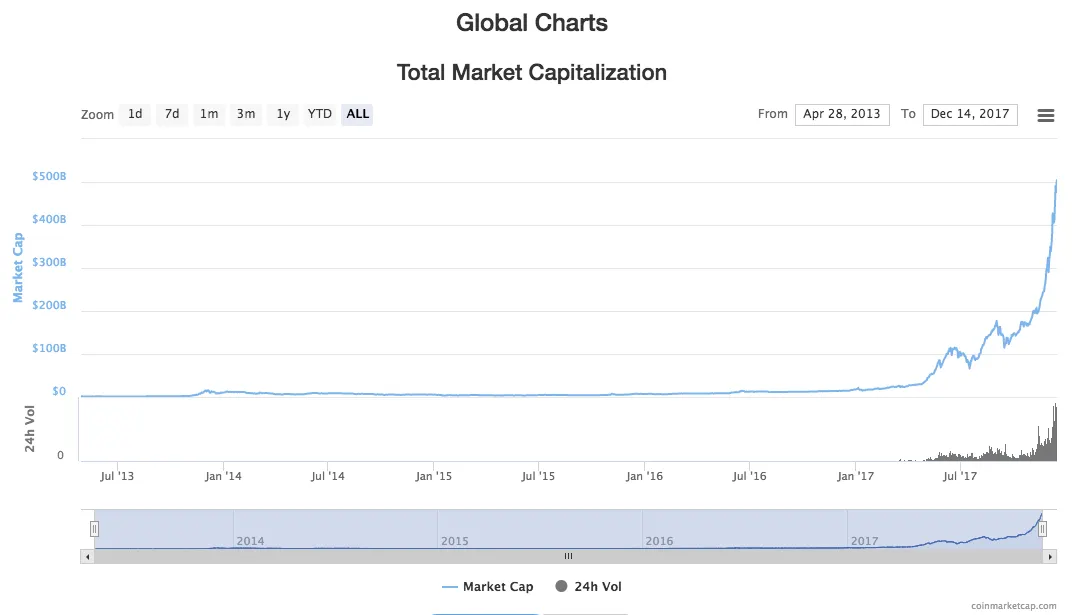
The total market cap of cryptocurrencies went from $18 billion at the start of the year to over $300 billion by the end of November. Want more? As I write this (December 14, 2017, 2:46 PM), it already surpasses $504 billion. That may sound like a lot in terms of value, but less than 1% of the world's population uses any kind of cryptocurrency.
And what many people don't know is that Bitcoin and cryptocurrencies in general (roughly 1,300 of them) are just a small fraction of everything that can be built using blockchain. New business models will emerge. Many traditional businesses can be — and will be — replaced by more efficient, less bureaucratic ones. Services made by people, for people.
What we're living through is just the beginning. 2017 for blockchain can be compared to 1994 for the internet. When the internet started to become popular among users, services like Uber, Facebook, Twitter, and others we use daily hadn't even been conceived. Only a small fraction of the population knew what the internet was, yet some people saw the opportunity and bet on the technology.
And that's exactly what we're witnessing with blockchain. People are just starting to hear about it. Few applications are being developed, and the number of services in use is even smaller. Just as in 1994 Google, Facebook, and Uber didn't exist, the products and businesses we'll use in the future haven't been imagined yet.
History repeats itself. The moment is one of new opportunities
Let's talk history again. In the late 80s and early 90s, the richest person in the world was the Sultan of Brunei, who flaunted a throne made entirely of gold, a gold-covered Rolls-Royce, and some 200 Ferraris (today that number is much larger — his car collection reaches 6,000).
From the late 90s to the present, that reality changed. Bill Gates took the lead, and along with him came a few more geeks who built their fortunes in their backyards, in makeshift offices (also known as garages).
But why did this happen? I'll quote a passage from an article I read: Don’t fall for the hype — Why Bitcoin’s $10,000 Price Doesn’t Reflect Its True Value (opens in a new tab)
Because there is much more value in a global network allowing people to store, exchange, and transfer information than in yellow shiny rocks and fossil fuels from under the ground. — Miguel Cuneta
And you know what? Blockchain is exactly that — but better, because it brings this power to each individual, eliminating the need for centralizers. Anyone with internet access will have the opportunity to be connected to the global market — to sell, produce, and manage their own information.
- A global network, but better — because it's not centralized. It's peer-to-peer, a network of people for people.
- Storing information on the blockchain is much more secure, because the data is immutable and distributed across the entire network.
- Exchanging and transferring information is guaranteed and verified by the entire network — and encrypted.
Once again, the opportunity is in our hands. This is the moment to learn the technology and make the most of it — to build a more transparent and efficient future, designed for each individual.
Shall we co-create the future?
Reading this in 2026
Mass adoption didn't arrive in almost a decade. Bitcoin is still a mystery to most people, a scam to others. But the foundations I wrote about in 2017 proved untouchable. No government shut it down. No hack broke the network. No crisis killed it. Bitcoin is stronger than ever — not because everyone uses it, but because institutional money now validates what a few of us believed back then.
We may still be distant from the kind of adoption I imagined while writing this. But the path ahead is clearer, not weaker.
Next in this series, I want to revisit the claims I made in 2017 — decentralization, trust, the internet parallel, the "new opportunities" — and hold them against what actually happened. Nine years is enough to separate conviction from hype.